

To introduce AI in a mid-sized company, pick one concrete, recurring process, test it in a small pilot on real data, and only then scale. You do not need a big strategy programme. What matters is a clearly scoped use case, one accountable person in the business unit, settled data protection questions, and an operating model that keeps the system running after the test. This guide shows where Germany's Mittelstand (its mid-sized, often family-owned companies) stands today, which obstacles really slow AI adoption down, and how to get from a first conversation to a live system.
Key takeaways
- 20 percent of German mid-sized companies used at least one AI technology between 2022 and 2024, mostly simple language and text tools (KfW).
- Technology is rarely the main obstacle. Companies struggle to find the first suitable use case, followed by legal uncertainty, missing skills and staff shortages.
- The safe way to start is one scoped process with clear success criteria, tested on real data within a few weeks.
- Data protection, access rights and human sign-off come before the first data access, not after.
- Lasting value only appears in operation: an AI system needs maintenance, monitoring and someone who turns corrections into rules.
How widespread is AI in mid-sized companies today?
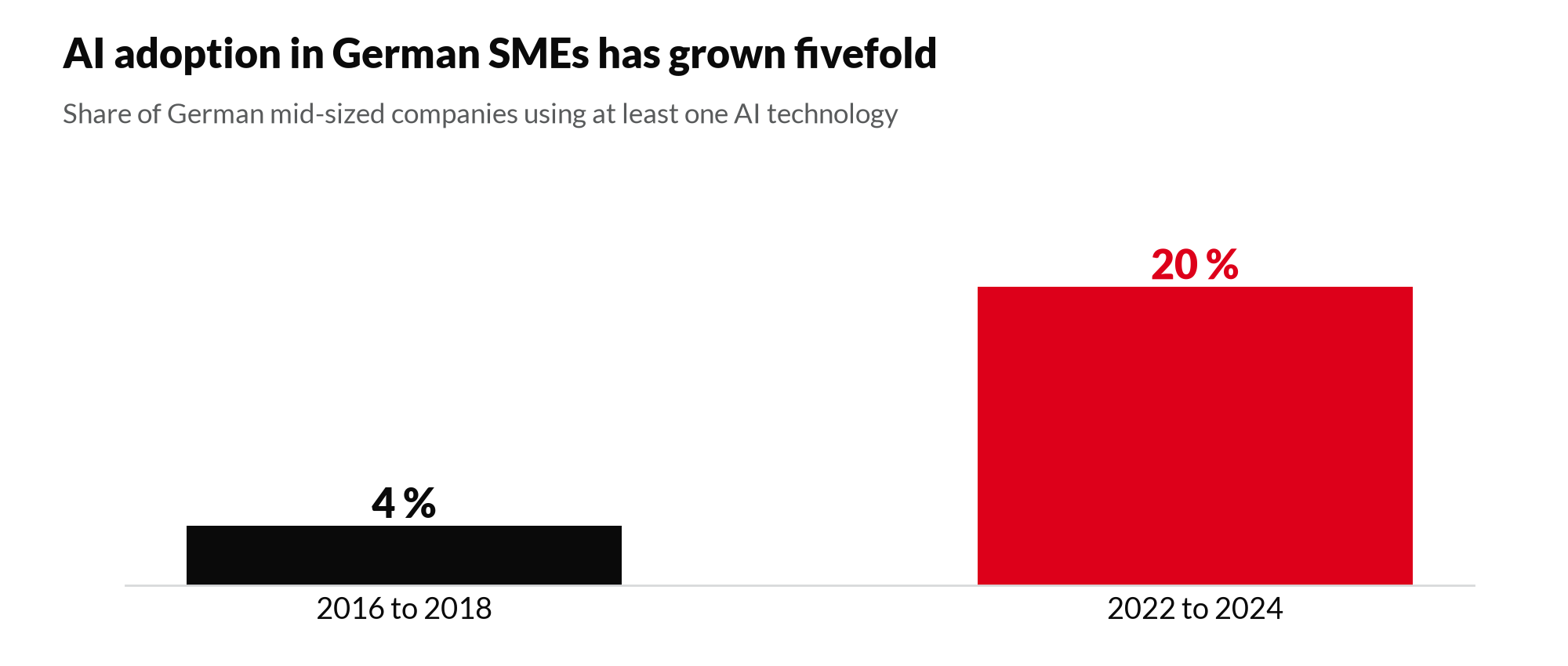
AI has reached mid-sized companies, but mostly in its simplest form. According to the KfW SME Panel, 20 percent of German mid-sized companies used at least one AI technology between 2022 and 2024, up from 4 percent in 2016 to 2018. The most common applications generate language (14 percent) or recognise text (10 percent). Only 3 percent use machine learning for data analysis.
Other surveys report higher figures because they look at different companies and periods. Bitkom Research found an adoption rate of 36 percent among 604 German companies with 20 or more employees in 2025, up from 20 percent a year earlier. The ifo Institute reported 54.5 percent across all German companies in its May 2026 business survey. These numbers do not contradict each other. They measure different things, but they point the same way: adoption is growing fast.
Depth matters more than the headline rate. Bitkom found that companies using AI run only two AI applications on average. Many stop at a writing and research tool that is neither connected to their own systems nor changes how work gets done.
What are the stages of AI adoption?
A simple maturity model helps you place your company. At Venista AI Studio we use five stages:
| Stage | What happens in the company | Typical value |
|---|---|---|
| 1 Awareness | AI is on the agenda, but not yet in daily work. | none yet |
| 2 Ad hoc | Individuals use chat assistants for writing and research, without access to company data. | personal, hard to measure |
| 3 Standardised | A company-wide AI assistant has been rolled out. | faster writing, unchanged processes |
| 4 AI workflows | Recurring processes run automatically and are connected to business systems. | measurable per process |
| 5 Agent organisation | Specialised AI agent teams work together, coordinated by a central orchestrator. | across departments |
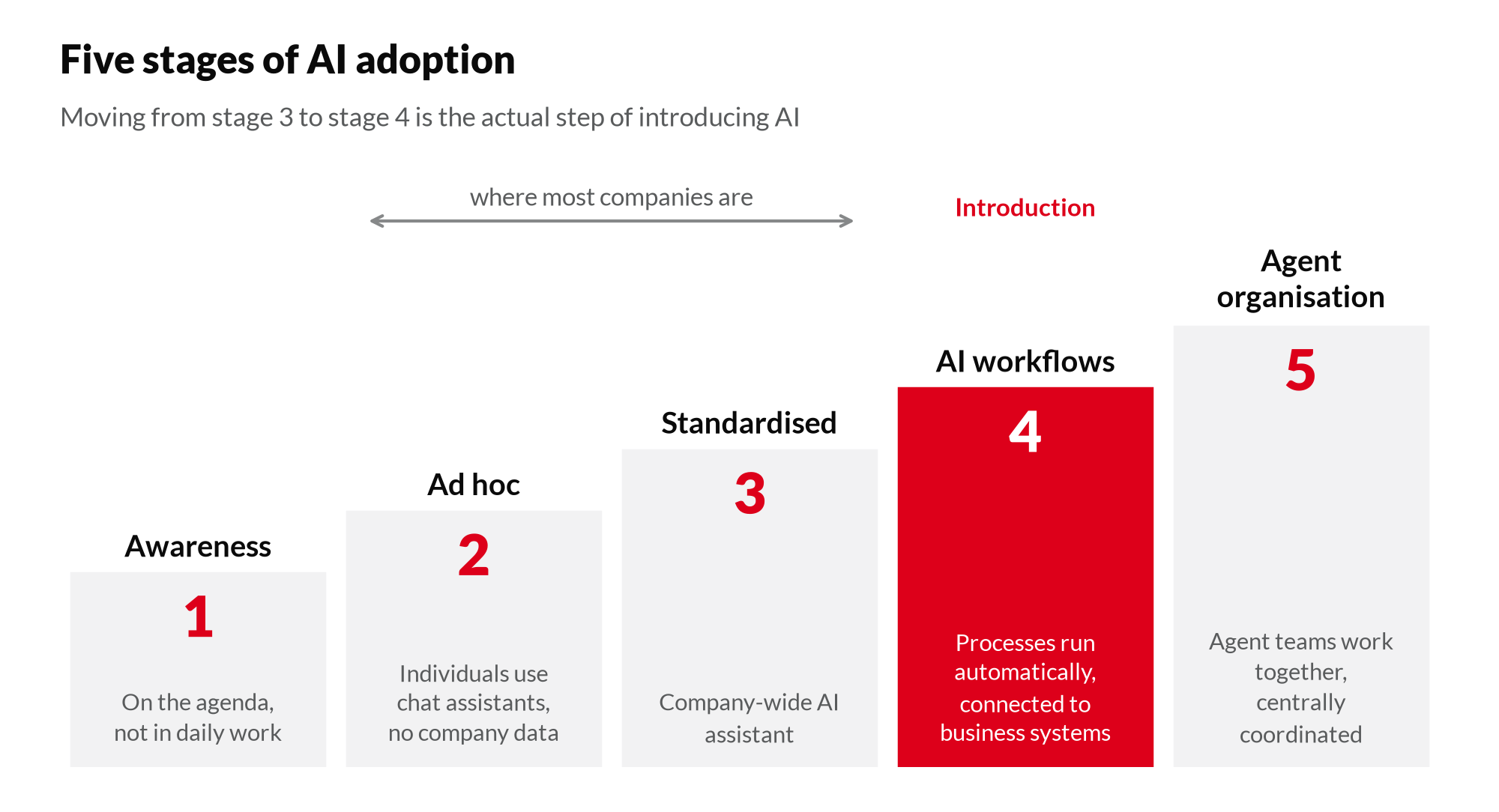
In our experience, most mid-sized companies sit at stage 2 or 3. Moving to stage 4 is the actual step of introducing AI. From here, AI works with your own data and takes over part of a process. You can read how we approach this step on how we work.
What holds back AI adoption in mid-sized companies?
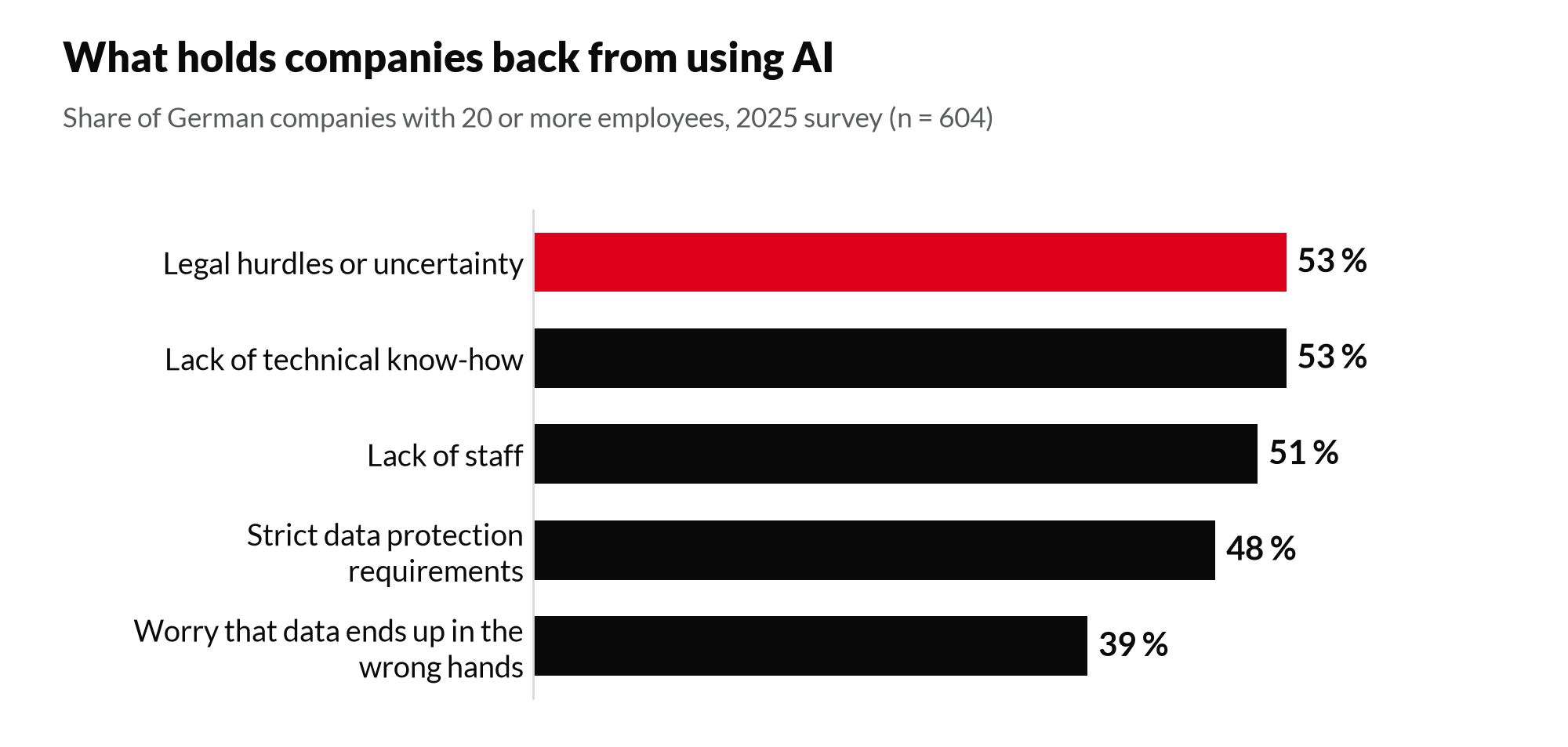
The biggest brakes are legal uncertainty, missing skills and too few people. In Bitkom's 2025 survey, 53 percent of German companies named legal hurdles or uncertainty, another 53 percent a lack of technical know-how, and 51 percent a lack of staff. 48 percent see strict data protection requirements as an obstacle, and 39 percent worry that company data could end up in the wrong hands.
KfW Research points to a hurdle that comes even earlier. Companies that use information sources such as trade journals, trade fairs, websites and advisory services adopt AI much more often. KfW reads this as a sign that identifying the first practical applications is a central hurdle. In plain terms: many companies would start if they knew where.
That suggests a clear order. Find the use case first. Then settle the legal and data protection questions. Then decide who builds and runs the system.
Where should a company start with AI?
Start with a recurring, clearly scoped process that costs noticeable time today. Good first candidates share four traits:
- Frequency: the task happens daily or weekly, not once a quarter.
- Data: the information it needs is digital, for example in emails, tickets, the ERP system or spreadsheets.
- Rules: experts can explain how they decide, even if there are exceptions.
- Ownership: one person in the business unit knows the process and can check results.
Typical starting points are customer enquiries, email triage, invoice processing, preparing quotes, and searching internal knowledge. KfW also names customer enquiries, email pre-sorting, invoice processing and AI as a knowledge source as typical applications. Our next article in this series looks at these five use cases one by one.
Processes that still change every week, depend on knowledge that only lives in people's heads, or have no owner are poor first choices. AI does not create order there. It only makes the missing order visible.
How does AI implementation work, step by step?
AI implementation works best in five steps, from the first conversation to live operation.
- Assess: determine where you stand and collect two or three candidate processes. A 30 to 60 minute conversation is usually enough.
- Scope: choose one process and define how success is measured, for example handling time, error rate or the share of cases prepared automatically.
- Secure: settle the data processing agreement, hosting, access rights per system and sign-off steps before any agent touches real data.
- Pilot: build and test the system on real data. With good data, two weeks is realistic; with several systems, closer to four.
- Run and expand: if the pilot convinces, the system goes into live operation. Then the next process follows.
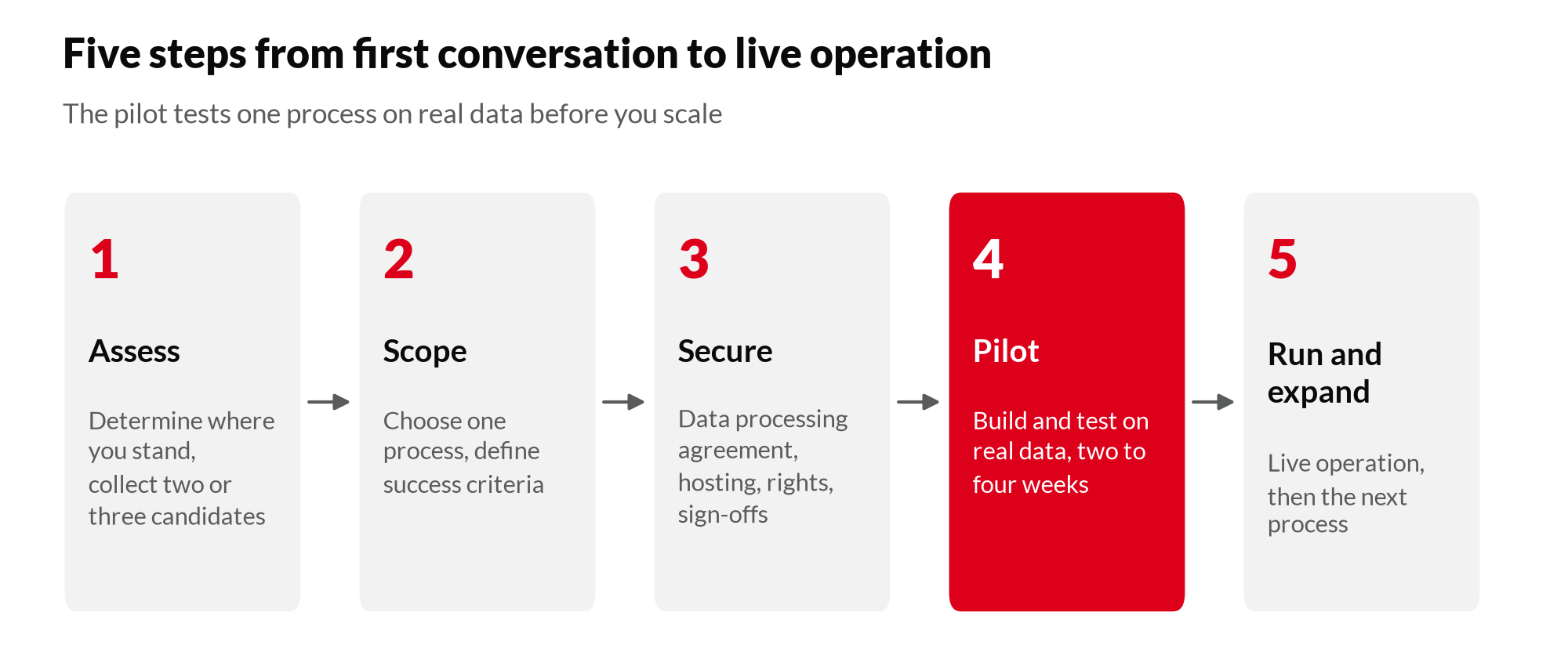
A pilot does not have to succeed to be useful. If it does not convince, you keep what you learned about your data and processes. Our fixed-price pilot page describes how we structure one.
How do you keep AI secure and GDPR compliant?
AI stays GDPR compliant when security is part of the architecture rather than an add-on. Four principles have proven themselves in our own operations:
- Read before write: agents read data. They only write after explicit approval, for example a ticket or a draft.
- Rights per task: each agent gets exactly the rights its task requires, set per system and revocable at any time.
- Humans at critical points: decisions, approvals and changes to the rulebook stay with your staff.
- Traceability: every action is logged, and every analysis is stored together with its query.
Contractually, a data processing agreement under the GDPR comes before the first data access. Where data is processed should also be settled up front. Bitkom shows how much this matters to German companies: 93 percent of those surveyed prefer AI from Germany. Our page on data security and hosting covers the hosting options and how the major model providers handle data. We will cover the rules of the EU AI Act in a separate article in this series.
Does a mid-sized company need its own AI team?
No. To get started, you do not need an in-house AI team, but you do need one accountable person in the business unit. Bitkom found that 51 percent of companies see a lack of staff as an obstacle, and only 5 percent specifically hire people with AI skills. Building your own team of specialists is neither quick nor easy.
What has to stay in-house is domain knowledge. The person who knows the process explains rules and exceptions, checks the first results and signs off. A service provider can handle the build, integration and technical operation. Make sure the rulebook and documentation belong to you, so that you can still move to self-operation later.
Broad training pays off as well. According to Bitkom, 43 percent of companies offer no AI training at all. Employees who understand what a system can and cannot do check its results better and bring ideas for the next process.
What happens after the pilot?
After the pilot comes operation, and that is where lasting value is created. An AI system is not a project you close. Business systems change, rules shift, new exceptions appear. Without maintenance, a good system quickly turns into one nobody trusts.
Operation covers four tasks: keeping the platform running, checking that every run receives complete data, turning staff corrections into fixed rules, and keeping costs per team under control. KfW stresses that mid-sized companies need to build a data culture to benefit from AI, from data collection to analysis. Day-to-day operation is where that culture takes shape. Our page on operations and support explains how we organise it.
What does an AI pilot look like in practice?
A real customer pilot in energy management shows how it works. A manufacturing company wanted to understand what caused its expensive peak loads. An AI agent team read meter data, machine and production data and linked them with weather and the operating calendar. All access was read-only.
The result: the most expensive peaks occurred in a few short time windows, mainly when several machines started up in the morning. A staggered start-up could be implemented without any investment. The agent did not control anything. It analysed the data, named the causes and proposed measures. The details are in our energy management use case.
Frequently asked questions
How long does it take to introduce AI in a mid-sized company?
You can test a first process within a few weeks. With good data, two weeks is realistic for a pilot; with several connected systems, closer to four. Rolling AI out across the whole company is a step-by-step expansion, one process at a time, with no fixed end date.
What does introducing AI cost?
Costs depend mainly on the scope of the first process, the number of connected systems, hosting and ongoing model usage. A fixed price for the pilot keeps the risk limited. We will cover the cost drivers in detail in a separate article in this series.
Do we have to clean up our data first?
Not completely. Choose a first process whose data is digital and largely complete. A good AI application checks data before analysing it and reports gaps instead of hiding them. You clean up where the process requires it.
Will AI replace jobs in mid-sized companies?
Two thirds of the companies surveyed by Bitkom (67 percent) expect no direct impact on headcount. In practice, AI first takes over preparatory work: gathering context, sorting, drafting. Deciding and signing off stays with people.
Conclusion
Introducing AI in a mid-sized company is less a question of technology than of sequence. A suitable first process, an accountable person, clear access rights and an operating model after the test take you further than any strategy paper. Start small and concrete, and within a few weeks you will know whether the next step is worth it.
Want to assess your first process? In a free initial conversation, we work out together where you stand and which use case suits a pilot. Get in touch
This article was written with AI assistance and editorially reviewed and approved by the Venista AI Studio team.