

The best first process for AI is the one where high value and good feasibility meet. Value means the process takes a lot of time today, repeats often, and mistakes or delays are costly. Feasibility means the data is digital, someone owns the process and the workflow is stable. With a simple scoring matrix you can compare several candidates with little effort. This article builds on our overview of five AI use cases to start with.
Key takeaways
- According to KfW Research, identifying first practical AI applications is likely a central hurdle for German mid-sized companies (Fokus no. 554, July 2026).
- Score every candidate on two axes, value and feasibility, with four criteria each on a scale from 1 to 5.
- Three knock-out criteria save time: no owner, knowledge that only exists in people's heads, a workflow that still changes every week.
- Start with a process in the top right of the matrix, not with the biggest process in the company.
Why does the choice of the first AI use case matter so much?
The first use case decides whether an AI project quickly shows what it can do or gets lost in preparation. In July 2026, KfW Research, the research unit of Germany's state development bank, analysed its SME panel (Fokus Volkswirtschaft no. 554, in German). It found that 20 percent of German mid-sized companies used at least one AI technology in 2022 to 2024. The study suggests that identifying first, practical AI applications is a central hurdle.
KfW Research also gives a reason. Mid-sized companies have to free up resources for new projects alongside their day-to-day business. As a result, overly complex applications are likely to be put on hold in favour of ones that are easier to implement. That is not a weakness but a useful compass. A small, clearly defined process with a good result convinces people internally far more than a large project that is still not running after months.
Which criteria should you use to prioritise AI use cases?
Score each process on two groups of criteria: value and feasibility. The idea is not new. For digitising internal processes, Fraunhofer IAO recommends a process portfolio analysis, in which criteria are rated from 1 to 5, grouped and plotted on a chart. Germany's Plattform Lernende Systeme likewise advises prioritising AI pilots by the highest added value and how quickly they can be implemented. We have adapted the criteria for AI agents.
Value criteria
| Criterion | Question | 1 point | 5 points |
|---|---|---|---|
| Time spent today | How many hours a week does the process take? | hardly any | many hours, several people |
| Repetition | How often does the same workflow run? | rarely, different every time | daily, following fixed rules |
| Cost of errors and delays | What happens when something is left undone? | little | annoyed customers, missed deadlines |
| Relief for experts | Does routine work tie up experienced staff? | no | yes, significantly |
Feasibility criteria
| Criterion | Question | 1 point | 5 points |
|---|---|---|---|
| Data | Is the information digital and readable? | paper, scattered notes | in systems with an interface or export |
| Process owner | Is there someone who knows the process and checks results? | nobody with time | a named person who is interested |
| Stability | How settled are the workflow and rules? | change constantly | unchanged for a long time |
| Impact of errors | Can a mistake be caught before it takes effect? | takes effect externally at once | a person checks before every action |
The last criterion is particularly important for AI. A good starting process is one where the agent proposes and a person approves. A mistake then becomes a correction, not damage.
Which processes should you rule out from the start?
Three kinds of process are ruled out before you award any points. These are the same knock-out criteria we use for our pilot:
- Processes without an owner. Without a contact person, nobody corrects and approves.
- Processes whose knowledge only exists in people's heads. An agent can only work with information it is allowed to access.
- Processes that still change every week. Hand a workflow over only once it has settled.
Plattform Lernende Systeme describes similar obstacles in its report "KI im Mittelstand" (2021, in German): a missing data basis, poor data quality and weak integration of data insights into existing business processes. Ruling a process out is not a final no. The gap can often be closed, for example by naming an owner or setting up a regular data export.
How does the scoring matrix work, step by step?
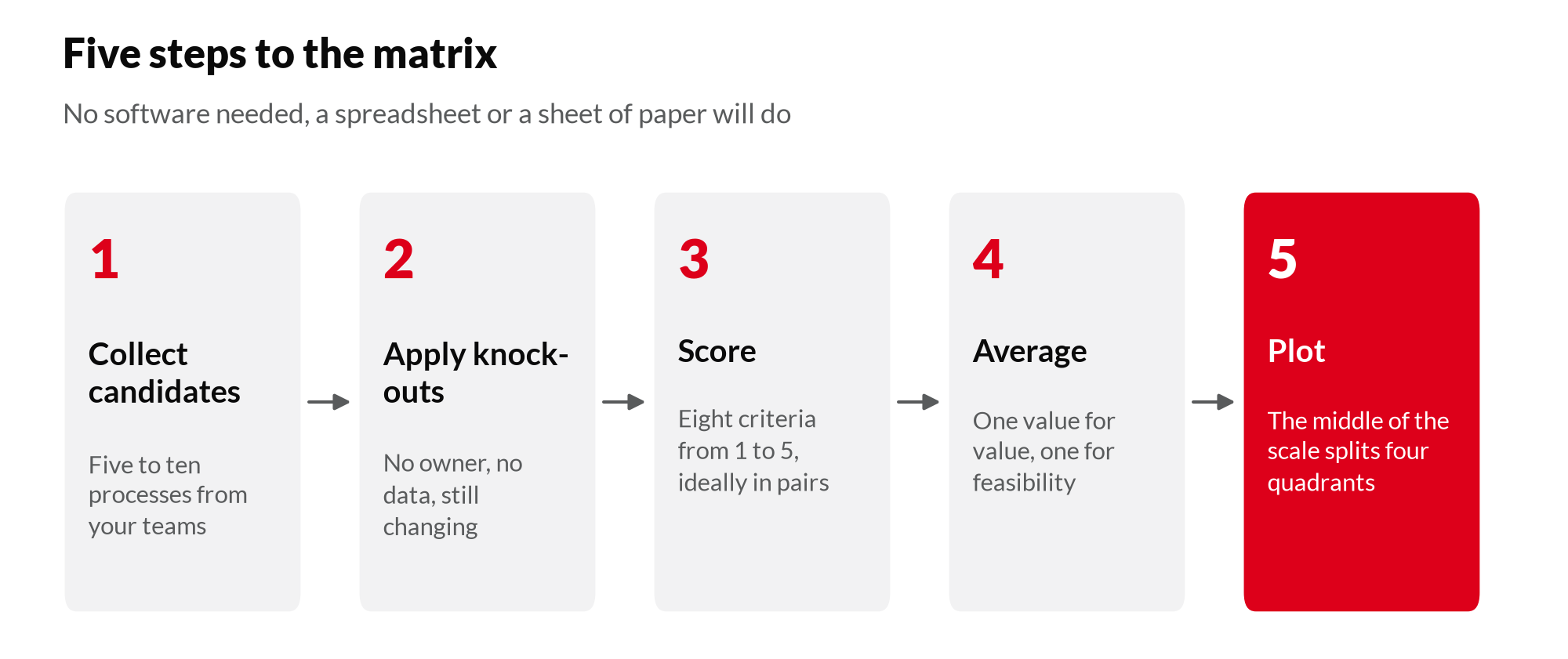
The scoring matrix takes five steps and needs no software. A spreadsheet or a sheet of paper is enough.
- Collect candidates. Ask your teams where hours go every week on searching, sorting or retyping. Five to ten candidates are enough.
- Apply the knock-out criteria. Remove anything without an owner, without digital data or still being reorganised.
- Score. Rate the remaining candidates on the eight criteria from 1 to 5. Ideally two people do it together: one from the business side, one who knows the systems.
- Average. Calculate one average for value and one for feasibility.
- Plot. Put value on the vertical axis and feasibility on the horizontal one. The middle of the scale, 3, splits the matrix into four quadrants.
| Quadrant | Value | Feasibility | What to do |
|---|---|---|---|
| Start here | high | high | make it your first pilot |
| Prepare | high | low | close the gap, such as data access or an owner |
| Add later | low | high | add once the first agent team is running |
| Park | low | low | do not pursue for now |
An illustrative example
The following example is made up and only shows how the matrix works. The scores are not measurements. A company has picked three candidates from the five starter use cases:
| Candidate | Value (average) | Feasibility (average) | Quadrant |
|---|---|---|---|
| Customer service enquiries | 4.5 | 4.0 | Start here |
| Quote preparation | 4.0 | 2.5 | Prepare |
| Triage of a shared mailbox | 2.5 | 4.5 | Add later |
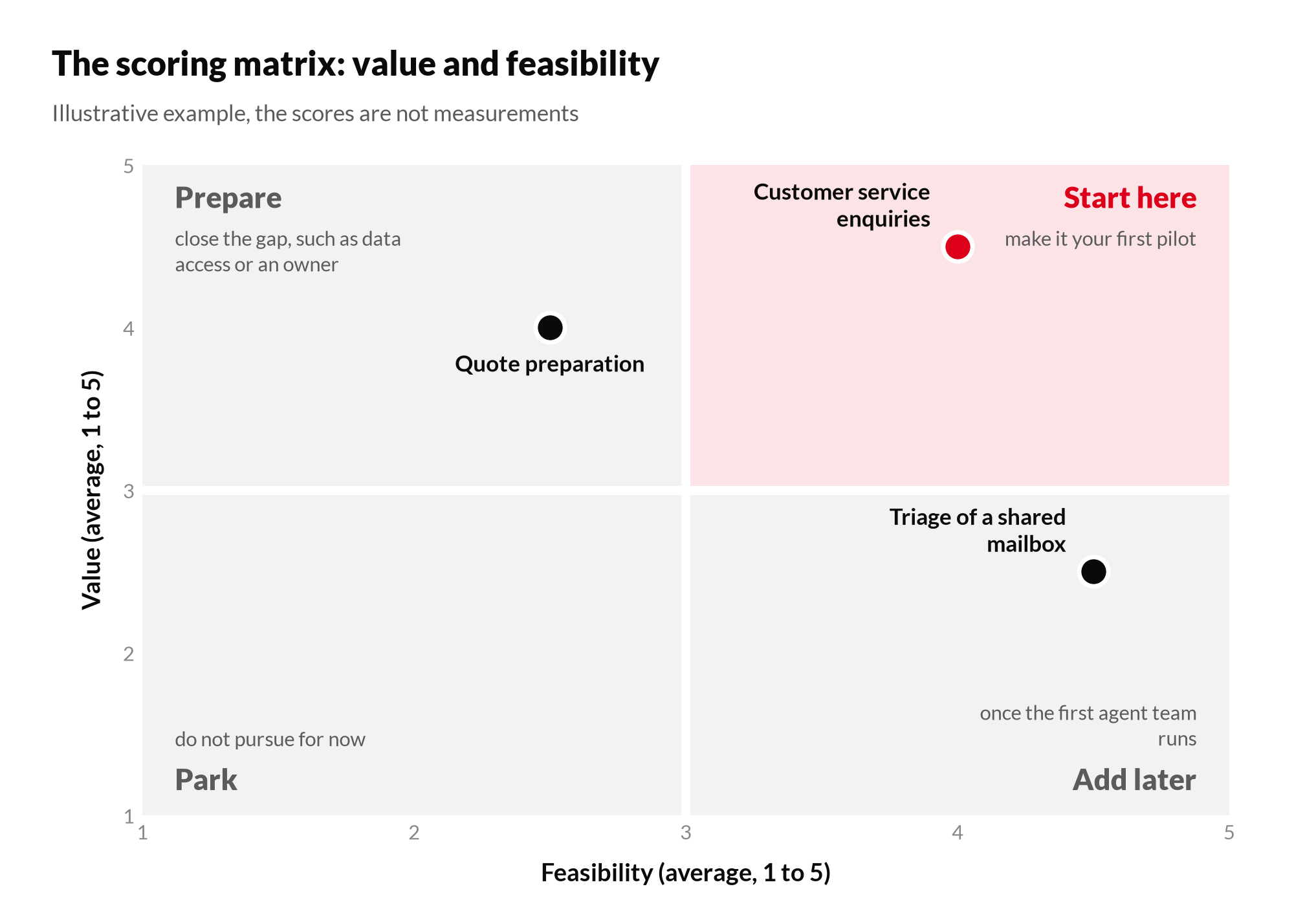
Customer enquiries arrive daily, keep several people busy and all the data sits in the ticket system. That is the first pilot. For quotes, many rules still live in the heads of experienced sales staff, so it pays to write them down first. Mailbox triage is easy to set up but brings little, so it comes later, once the first team is running. Our customer service use case shows how an agent team works in service.
What if two candidates score the same?
If two candidates are level, pick the one that will deliver a visible result faster. That is usually the process with fewer systems. Every extra system means another access, more permissions and more coordination. On our pilot page we plan for two weeks where data is good and closer to four where several systems are involved.
A second tiebreaker is visibility. A process that frustrates many colleagues builds momentum for the next step once it works well. A process only one person knows rarely convinces anyone beyond that department.
Frequently asked questions
How many processes should we score at the start?
Five to ten candidates are enough for a good choice. More candidates do not make the result more accurate, only slower. What matters more is that the business side and IT score together, so processes with poor data stand out early rather than halfway through a project.
Do we need to weight the criteria?
Not for the first round. A simple average per axis is enough to spot candidates to start with. If you have a specific goal, such as relieving customer service, you can count individual criteria twice. Just set the weighting before you score, not afterwards.
What if no process lands in the start here quadrant?
Then the bottleneck is usually feasibility. Take the candidate with the highest value from the prepare quadrant and close the gap on purpose, for example with a data export or a named owner. That often moves it to the top right.
Do we need outside help to score our processes?
No, the matrix works without consultants. An outside view helps when it is unclear what an agent can do technically. We clarify that in a free initial conversation, as described in how we work.
Conclusion
You do not find your first AI process through technology but through two questions: where do we lose the most time today, and where is the data already in place? The scoring matrix makes those questions comparable, and three knock-out criteria filter out what is not ready yet. The candidate in the top right is the process for your first pilot. For the bigger picture, read our guide on how to introduce AI in a mid-sized company.
Have several candidates and want a second opinion? In a free initial conversation, we score your processes together. Get in touch
This article was written with AI assistance and editorially reviewed and approved by the Venista AI Studio team.